Second Incheon-Jeju A2CL Summit Connects Aerospace and AI Talent Development
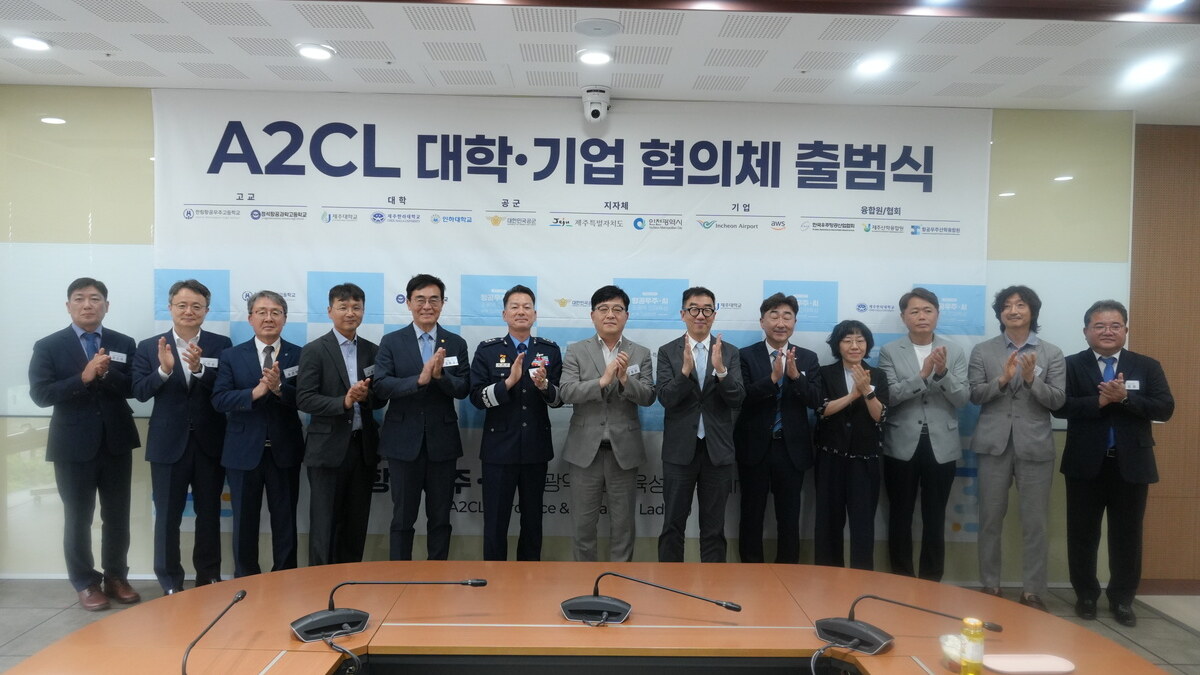
Cheju Halla University’s Anchor Project Division took part in the Second Incheon-Jeju A2CL Summit at the Aerospace Industry Convergence Institute in Incheon. The summit brought together Incheon Metropolitan City and Jeju Special Self-Governing Province to connect Incheon’s aircraft maintenance, repair and overhaul (MRO) base with Jeju’s NewSpace industry base, and to discuss a super-regional talent and settlement ecosystem for aerospace and artificial intelligence.
Participants included Cheju Halla University, Inha University, Jeju National University, the Republic of Korea Air Force, Incheon International Airport Corporation, Amazon Web Services (AWS), the Korea Aerospace Industries Association, the Aerospace Industry Convergence Institute, the Jeju Industry-Academia Convergence Institute, partner companies, and aerospace-focused high schools. The participating institutions adopted a launch declaration for the A2CL university-industry council, turning the shared vision into a more concrete cooperation structure.
A2CL: Aerospace & AI Career Ladder
A2CL stands for Aerospace & AI Career Ladder. It is a super-regional talent-development model that connects education, career development, employment, incumbent-worker upskilling, and local settlement across aerospace and AI. By linking Incheon’s aerospace MRO capabilities with Jeju’s NewSpace capabilities, the model creates a full talent pathway that neither region could build as effectively on its own.
A 4-4-3 model for the full talent pathway
A2CL is built around a 4-4-3 model: four growth engines, a four-stage career ladder, and three support platforms. Together, these elements connect learning and career development with the needs of industry and the wider region. The four growth engines cover the digital transformation of aerospace MRO and engine maintenance, safe drone and urban air mobility operations, aerospace AI, and aircraft maintenance and airworthiness certification.
The four-stage ladder moves from secondary-school science, technology, engineering, and mathematics (STEM) education to Air Force-linked education and credit acquisition, employment through contract-based university programs, and advanced study or upskilling for graduate-level learners and incumbent workers. The three support platforms cover AI-based education and industry data, technology commercialization and demonstration, and industrial growth support.
The goal is a pathway in which aerospace and AI talent can move from education into research and development, field demonstration, employment, and long-term settlement in the region.
Why this matters to AI education
For the Department of AI at Cheju Halla University, the collaboration makes the link between data- and AI-based problem solving and real aerospace needs more visible. When industry demand and regional demonstration environments become part of education, students can learn to apply AI not as an isolated tool but to aerospace, robotics, and data problems in a real operating context.
Young Joon Lee, Cheju Halla University’s Super-Regional Growth Engine Project Director, said the summit helped turn a super-regional aerospace and AI talent-development model into a concrete plan connecting Incheon’s MRO base with Jeju’s NewSpace base. He added that the partners would continue building a sustainable ecosystem in which learning, career development, employment, and local settlement reinforce one another.
Official source
Share