

An AI-Powered 'KBS Jeju Election Coverage Center': Cheju Halla AI Department Drives Korea's First Local Case
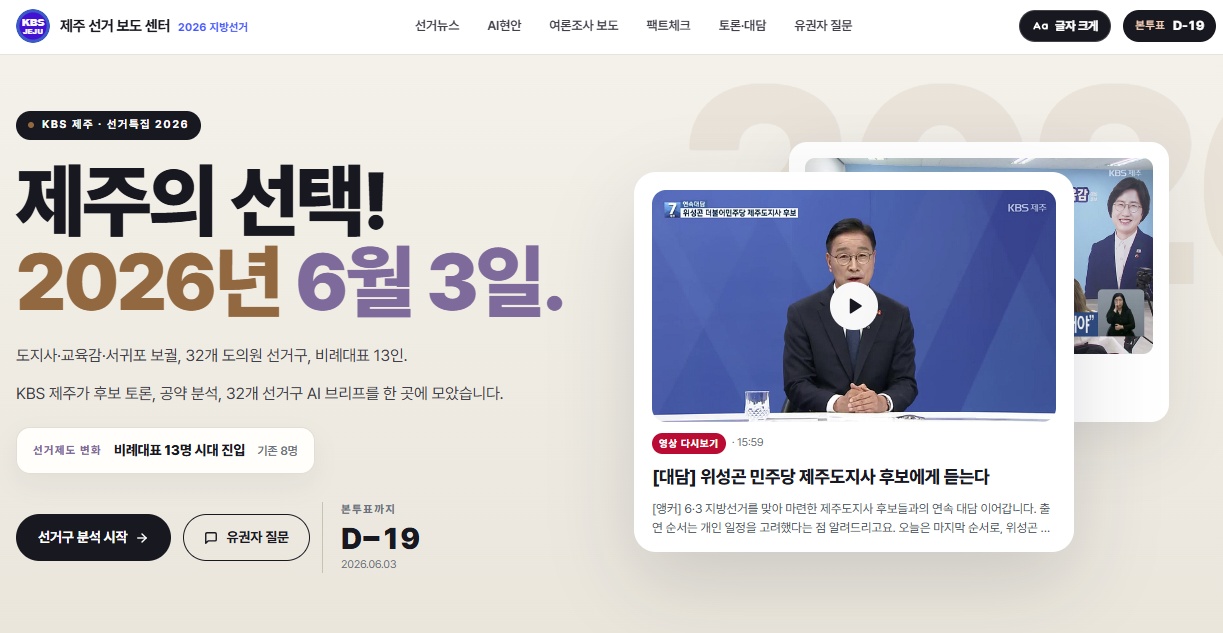
The Department of AI at Cheju Halla University (Prof. Young Joon Lee’s research team) and KBS Jeju have jointly launched ‘KBS Jeju Election Coverage Center’ (vote-jejukbs.kr), an AI-powered platform unveiled on May 15, just 19 days before Korea’s June 3 local elections. It is the first ‘AI × election coverage’ case ever produced by a newsroom on Jeju Island, designed to help local voters, too often sidelined in Seoul-centric election broadcasts, explore election information more easily and in greater depth.
How the Collaboration Began: AI Analysis of 32 Electoral Districts
The partnership between KBS Jeju and the AI Department began in March. The two teams used AI to analyze the core issues of all 32 electoral districts in Jeju, layered in the voices of local residents, and produced weekly news segments combining AI audio and AI-generated graphics. The series ran 11 times and led the way toward issue-based reporting, becoming the foundation of this new interactive platform.

Interactive Map: One Click, the Whole District
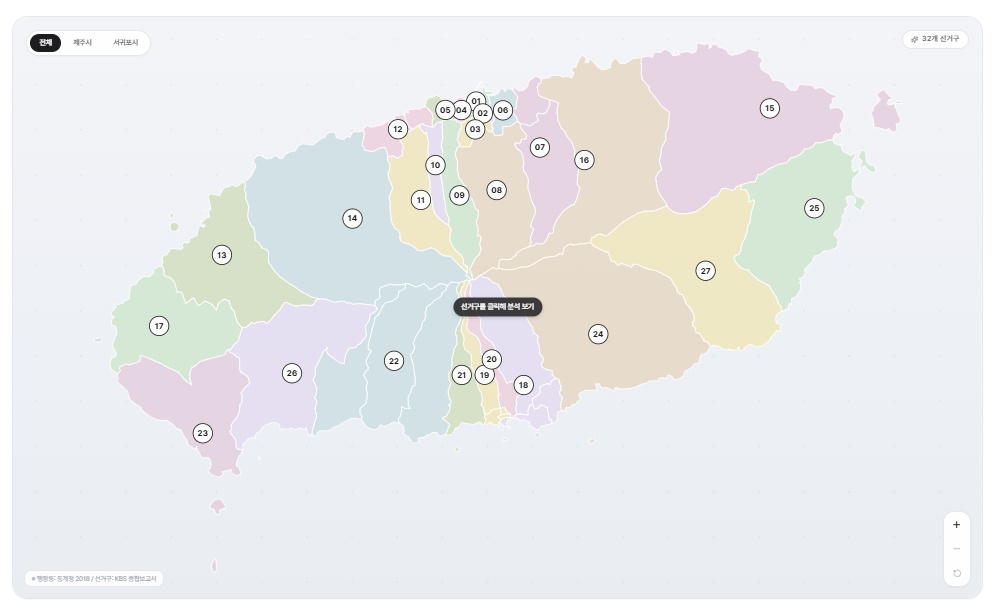
The platform’s signature feature is its map-based district explorer. Click any of the 32 districts and a single view opens: population, key local issues, the candidates running, and the AI-curated news for that area. Click “Aewol-eup, Jeju City,” for example, and you can instantly compare who is running, what the local issues are, and what each candidate has pledged.
Policy Knowledge Graph: Structuring Each Candidate’s Promises
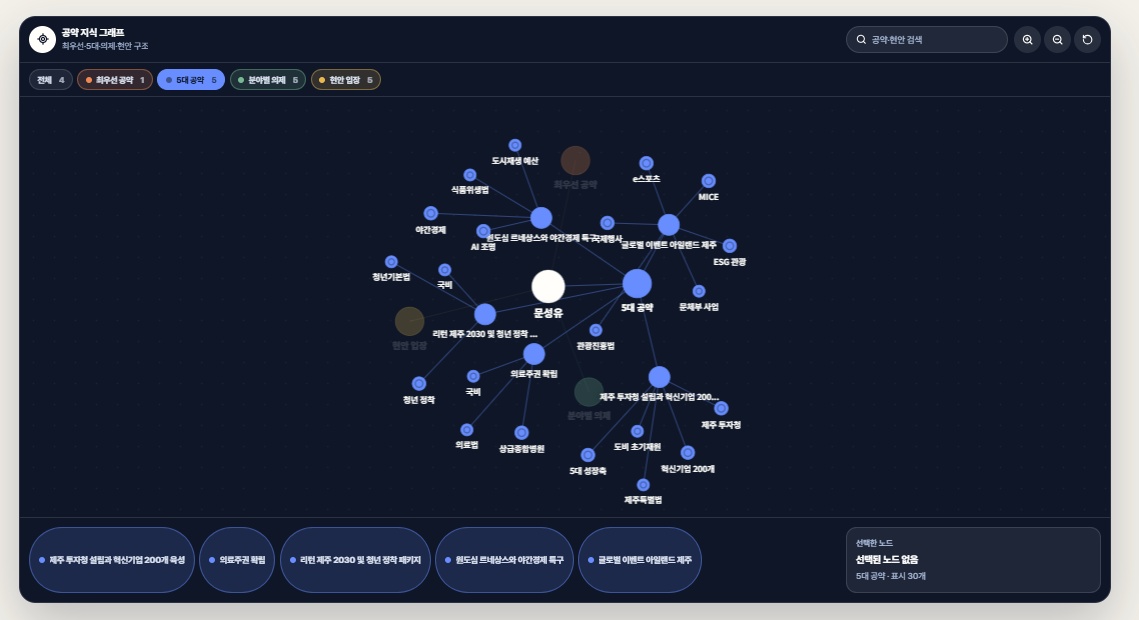
The feature the department invested most effort in is the policy knowledge graph. Candidates submit their ‘top priority pledge,’ ‘top five pledges,’ ‘sector-level agenda,’ and ‘positions on local issues,’ which are then visualized as a node-link graph. Voters can intuitively compare which pledges each candidate is committed to delivering on, and how their responses to the same local issues differ. Based on candidates’ answers to a public questionnaire, the AI also produces a short summary of each candidate’s strengths and limitations.
Voter Participation: A Direct Channel to Candidates
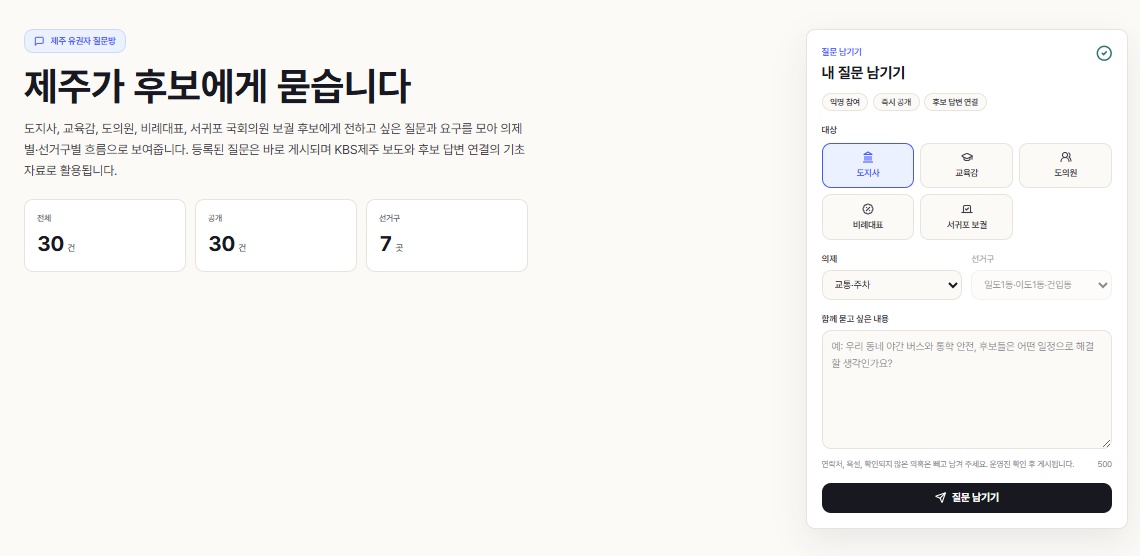
The platform does not stop at consumption. It is built so that voters can directly post questions to candidates for governor, education superintendent, provincial council, proportional representation, and the Seogwipo parliamentary by-election; questions are sorted by topic and district. Candidates then reply to those questions in-thread. Politicians who used to feel distant and voters who used to feel unheard now meet on a single digital town square.
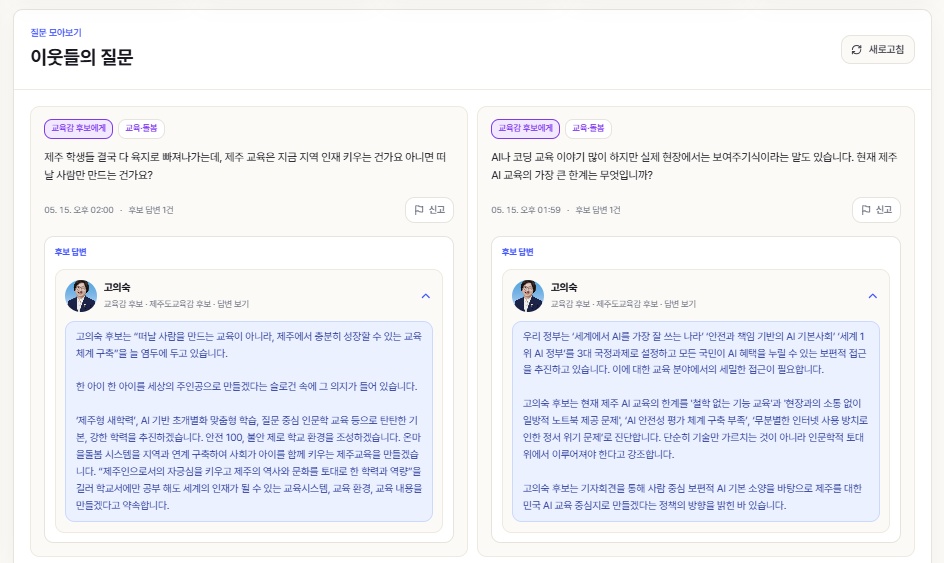
Designing for Trust: AI Curation + Human Editorial Review
The hardest problem in applying AI to election coverage is trust. Rather than naively pulling articles that simply contain the word “election,” the team designed the system to gather and organize stories with full context: candidates, parties, districts, pledges, and polling data. They also built in a two-layer safeguard: an editor makes the final call on what is published, on top of the AI’s automatic classification, blocking the risk of AI making arbitrary editorial decisions on its own.
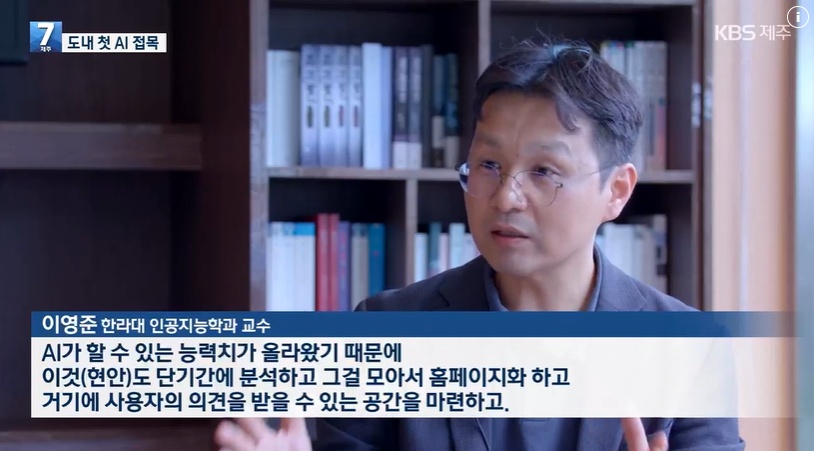
In his KBS interview, Prof. Lee said: “Previously, planning, designing, and actually building a system like this would have taken a great deal of time, but thanks to how far AI capabilities have come, we were able to do it in a short window.” He added, “I was honestly worried about whether AI would arbitrarily generate wrong information on such a sensitive topic, so we kept examples of what should be excluded and put an editor at the final review step, in order to secure trust.”
Why It Matters, and What’s Next
This collaboration is significant as the first model in which a local newsroom, a university, and AI come together to expand democratic participation. Pledges and agendas from minor-party proportional candidates, whose voices are easily drowned out by the two major parties, are also given their own dedicated section, providing balanced information to voters considering their party vote. In addition to the gubernatorial candidates already visualized, education superintendent candidates and the Seogwipo parliamentary by-election candidates will be added as their responses come in.
Building on this collaboration with KBS Jeju, the AI Department has shown that AI, used well in the public sphere, can narrow information gaps and act as a trustworthy civic-participation tool. The department plans to expand applied-AI projects that are tightly coupled with the local community.
Related Links
- KBS Jeju Election Coverage Center: https://www.vote-jejukbs.kr
- Original KBS report (May 15, 2026): https://news.kbs.co.kr/news/pc/view/view.do?ncd=8562098&ref=A
Share